En Égypte : notes de voyage by Maurice Maeterlinck
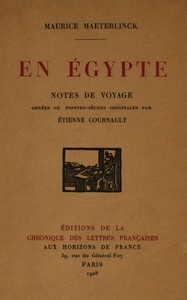
"En Égypte" by Maurice Maeterlinck is a travelogue written in the early 20th century. It contrasts postcard images of Egypt with on-the-ground reality, then turns into a reflective inquiry into Pharaonic art, religion, funerary culture, and the pull between myth and fact. The result is a meditative journey that uses modern impressions to interpret ancient temples, tombs, and beliefs for the curious traveler. The opening of the work urges readers to travel if they value reality over comforting fantasy, then sketches present-day Egypt much as clichés promise—pyramids, palms, donkeys, chadoufs and sâkiyés, dusty villages, and disappointing big cities—before setting aside mosques and Arab art to focus on the Pharaonic world. It presents Egyptian monuments as uniquely overwhelming yet, once absorbed, profoundly formative—even prefiguring Greek architecture—arguing they must be seen in their native light and landscape. Art is shown as largely documentary and ritual in purpose, yet capable of austere grandeur and tender realism; alongside masterpieces, the Tutankhamun finds reveal astonishing kitsch. The narrative then outlines a civilization built around death—momies, tombs, and provisions for the “Double”—tempered by everyday pleasures and even texts that preach a quiet carpe diem. It scrutinizes priestly “science,” suggesting the Great Pyramid may encode striking measures while most engineering was simple and massive, and recasts famed magic as a mix of hypnosis-like practices, formulas from the Book of the Dead, and occasional stagecraft. A deeper, often hidden creed emerges: a pantheistic, almost monotheistic agnosticism expressed through Osirian mysteries as dramas of death and rebirth, later overgrown by popular magic and totemic residues. The judgment of the dead, with its negative confession and weighing of the heart, leads to deification—or, failing that, to depicted punishments—though many souls prefer to linger near their mummies. Finally, the tone shifts to the human: the vanity of rulers like Ramesses II, a practical, pleasure-accepting social life with frank sexual mores, and an ethical ideal that exalts truth. (This is an automatically generated summary.)

Read or download for free

For an overview of the different reading options, see our Reading Guide

Reading Options Url Size
Read now! https://www.gutenberg.org/ebooks/77407.html.images 116 kB
EPUB3 (E-readers incl. Send-to-Kindle) https://www.gutenberg.org/ebooks/77407.epub3.images 758 kB
EPUB (older E-readers) https://www.gutenberg.org/ebooks/77407.epub.images 757 kB
EPUB (no images, older E-readers) https://www.gutenberg.org/ebooks/77407.epub.noimages 134 kB
Kindle https://www.gutenberg.org/ebooks/77407.kf8.images 935 kB
older Kindles https://www.gutenberg.org/ebooks/77407.kindle.images 923 kB
Plain Text UTF-8 https://www.gutenberg.org/ebooks/77407.txt.utf-8 107 kB
Download HTML (zip) https://www.gutenberg.org/cache/epub/77407/pg77407-h.zip 716 kB
There may be more files related to this item.

About this eBook

Author Maeterlinck, Maurice, 1862-1949
Illustrator Cournault, Etienne, 1891-1948
Title En Égypte : notes de voyage
Original Publication Paris :Éditions de la chronique des lettres françaises, 1928.
Credits Laurent Vogel and the Online Distributed Proofreading Team at www.pgdp.net (This book was produced from images made available by the HathiTrust Digital Library.)
Language French
LoC Class DT: History: General and Eastern Hemisphere: Africa
Subject Egypt -- Description and travel
Category Text
EBook-No. 77407
Release Date
Copyright Status Public domain in the USA.
Downloads 261 downloads in the last 30 days.
Project Gutenberg eBooks are always free!